The Label Says Fragrance-Free. Your Nose Disagrees. Let's Settle This.

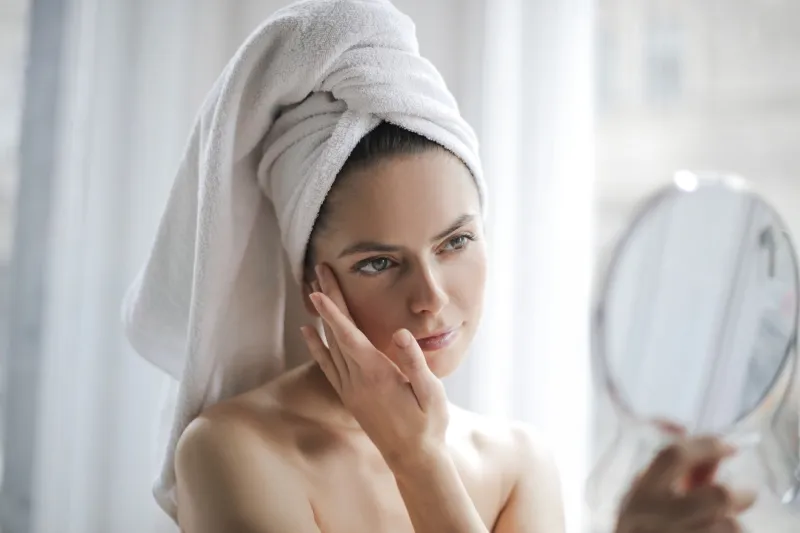
Photo: woman reading ingredient label on skincare bottle in bathroom mirror light, via cdn.pixabay.com
You're in the skincare aisle, bottle in hand, and the back label says unscented. You pop the cap and — huh. That's vanilla. Or clean laundry. Or something vaguely spa-adjacent. Nothing offensive, but definitely a smell.
So what gives?
Short version: in the United States, neither "unscented" nor "fragrance-free" is a regulated term with a fixed definition. They mean whatever the brand using them intends, within the fairly loose boundary of "don't put something false on the label." Which is exactly why the two words get swapped around in marketing copy and almost never get swapped around in a formulation lab.
Here's how to tell them apart, why the distinction matters if your skin runs reactive, and how to scan a back label without a chemistry degree.
What US law actually requires (spoiler: not much)
Cosmetics labeling falls under the FDA, which bans misbranding but has never issued a formal definition for "fragrance-free" or "unscented." The agency's position is essentially: don't make claims that are false or misleading. That's it.
The one rule that genuinely shapes your ingredient list: fragrance and flavor ingredients may be disclosed collectively as "fragrance" or "parfum." One word on the label can legally stand in for a blend of dozens of individual compounds. The EU requires brands to disclose certain fragrance allergens above set thresholds. The US does not.
So when a bottle announces it's fragrance-free, you're reading a brand's promise, not a regulatory category. Worth knowing before you trust it.
Unscented is not a synonym for fragrance-free
The working industry understanding goes roughly like this:
Fragrance-free usually means nothing has been added for scent — not to perfume the product, not to mask anything either.
Unscented usually means the product has no perceptible smell. And here's the catch: the standard way to get a raw material that smells like raw material to smell like nothing is often to add — a fragrance. A masking fragrance, specifically, engineered to neutralize rather than perfume.
That's why an unscented serum can still list "fragrance" in the ingredients, and why an unscented product can absolutely trigger a reaction in someone with fragrance sensitivity.
Is that deceptive? Sometimes. Often it's a defensible formulation choice — the alternative might be a lotion that smells faintly of hot plastic. The problem isn't the technique. The problem is that the label doesn't explain it, and shoppers reasonably assume unscented means nothing in here. It doesn't.
Essential oils are fragrance. Full stop.
Lavender. Citrus peel. Peppermint. Geranium. Rose. All natural, all plant-derived, all lovely in a diffuser — and all fragrance as far as your immune system is concerned.
The molecules that give essential oils their scent (limonene, linalool, citronellol, geraniol, eugenol) are also among the most frequent culprits in allergic contact dermatitis from cosmetics. Fragrance consistently ranks among the top allergens in dermatology patch-test data. That's not a knock on plants. It's just how sensitization works.
"Clean" and "natural" don't mean hypoallergenic. A rose absolute can irritate skin just as effectively as a synthetic musk, and it photographs better while doing it. If your barrier is currently unhappy — an eczema flare, a retinol adjustment, the dry stretch of January — botanical fragrance is not the gentler choice. It's the more marketable one.
How to scan a label in 30 seconds
- Find fragrance, parfum, or aroma in the ingredient list. Position matters, since ingredients are listed in descending order of concentration. Fragrance near the top is a lot of fragrance.
- Look for individual fragrance allergens: limonene, linalool, citronellol, geraniol, eugenol, hexyl cinnamal, benzyl salicylate, coumarin.
- Spot the scented botanicals: lavender oil, citrus peel oil, peppermint oil, rose flower oil, or a vague "essential oil blend."
- Watch for "masking fragrance" or "scent neutralizer."
- Cross-check the front against the back. If the front says fragrance-free and the back lists fragrance, you have your answer.
Cheat sheet, category by category
Cleansers
Rinse-off, low stakes for most people — but not zero. There's no real benefit to perfuming something that touches your face for 45 seconds, so if you're reactive, go fragrance-free here by default.
Moisturizers and serums
Highest stakes. Long contact time, and the product sits on a barrier that may already be compromised. If you use retinoids or exfoliating acids, treat fragrance-free as the baseline rather than a bonus feature.
Makeup
Foundation, powder, and setting spray frequently carry fragrance, and it's easy to forget that your base layer is a leave-on product too. Lip products deserve extra scrutiny — you ingest a little of everything you wear.
Body wash, lotion, and hair care
The biggest bottles, the most fragrance, the largest surface area. This is also where "unscented" language shows up most often. If you have eczema or sensitive skin, this is the category where switching to fragrance-free tends to pay off fastest.
Do an actual patch test (five minutes, spread out)
Apply a small amount to your inner forearm or behind your ear, twice a day for three to five days. Don't test it the same week you introduce three other new products, and don't test on broken skin. Fragrance reactions are often delayed — 24 to 72 hours — so a sniff test tells you precisely nothing about what your skin will do.
The bottom line
Fragrance isn't the villain of this story, and plenty of people wear it without a single issue. But if you're buying something because the label promised it was gentle, you deserve to know whether "unscented" meant no added scent or we covered the smell with something else. Read the back of the bottle. The front is marketing. The ingredient list is the receipts.